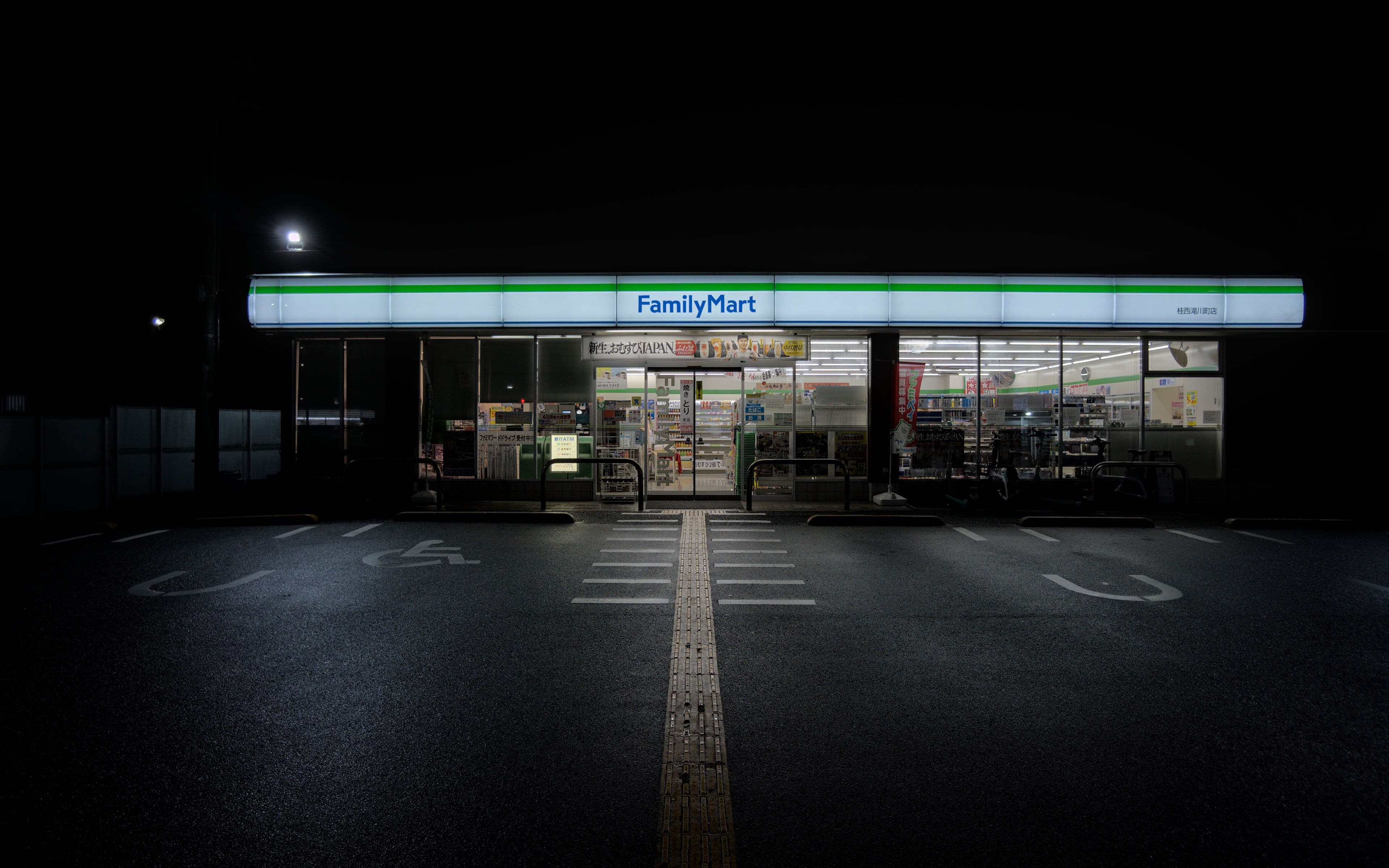
How a Convenience Store Became Cooler Than You
There's a certain kind of magic in watching a convenience store outgrow the phrase "convenience store." Family Mart has spent the last year and a half doing exactly that, one collaboration at a time, and the result reads less like a corporate rebrand and more like a slow, deliberate glow-up nobody asked for but everyone secretly wanted.
Start with the socks. Every summer, Fuji Rock Festival turns into a mudfield with a soundtrack, and for four years running, Family Mart has shown up with a Convenience Wear capsule built for exactly that chaos — ribbed socks for the trench-foot years, Imabari towels for the heatstroke years, and now kids' sizes for the years someone finally decided festivals are a family sport. It's cheap, it's functional, and it sells out, because nothing says "I understand my customer" quite like knowing they'll be standing in a swamp for six hours and still want to look put together.
That's the part Family Mart has always been good at: showing up exactly where its customers already are. The plot twist is what happened next — it stopped waiting to be needed and started trying to be wanted.
Enjoying this? Get new articles by email.
Enter NIGO. The man behind BAPE, the guy who spent years steering Kenzo, took a job as Family Mart's creative director, and if that sentence still sounds slightly absurd to you, you're not alone. Konbini don't usually hire streetwear royalty. But NIGO himself has said convenience stores capture Japan's everyday lifestyle and culture better than almost anything else, and honestly, he's not wrong — he just might be the first person with the cultural clout to say it out loud and have people believe him.
The results showed up fast. In July, FamilyMart opened FAMIMA PARK AZABUDAI in Tokyo — a flagship with a rooftop garden, a full Convenience Wear boutique complete with fitting rooms, staff uniforms NIGO designed himself, and architecture from Wonderwall's Masamichi Katayama, the same designer who shaped BAPE's earliest stores. Somewhere along the way, "grab a rice ball and go" turned into "grab a rice ball, browse a capsule collection, and maybe stay for the coffee from a World Barista Champion." FamilyMart's own president has framed the partnership as a way to deepen the brand's distinctly Japanese sensibility — corporate-speak, sure, but the store itself backs it up.
What makes this genuinely clever, rather than just expensive, is the range of the collaborations. Fuji Rock ties Family Mart to music and festival culture. NIGO ties it to fashion and streetwear history. The in-house Convenience Wear line — its own socks, towels, and basics — means it isn't just borrowing credibility, it's building a wardrobe. Add a flagship store built as a destination, not a pit stop, and you've got a brand hitting culture from three directions at once instead of betting everything on one big-name partnership and hoping it lands.
It's a genuinely funny thing to watch happen to a place best known for fried chicken and ATMs. But that's the trick — Family Mart isn't trying to become a fashion house. It's trying to become the thing you don't think twice about needing, the way family doesn't need an explanation. Somewhere between the mud-proof socks and the rooftop garden, a convenience store quietly became a companion. Turns out the secret to relevance was never reinvention — it was just paying enough attention to become indispensable in more ways than one.