Photo: NBA.com
The NBA Is Testing a Smart Basketball. Does AI Make the Game Fairer or Just Flatter?
From the outside, it is just a basketball. That is the whole point.
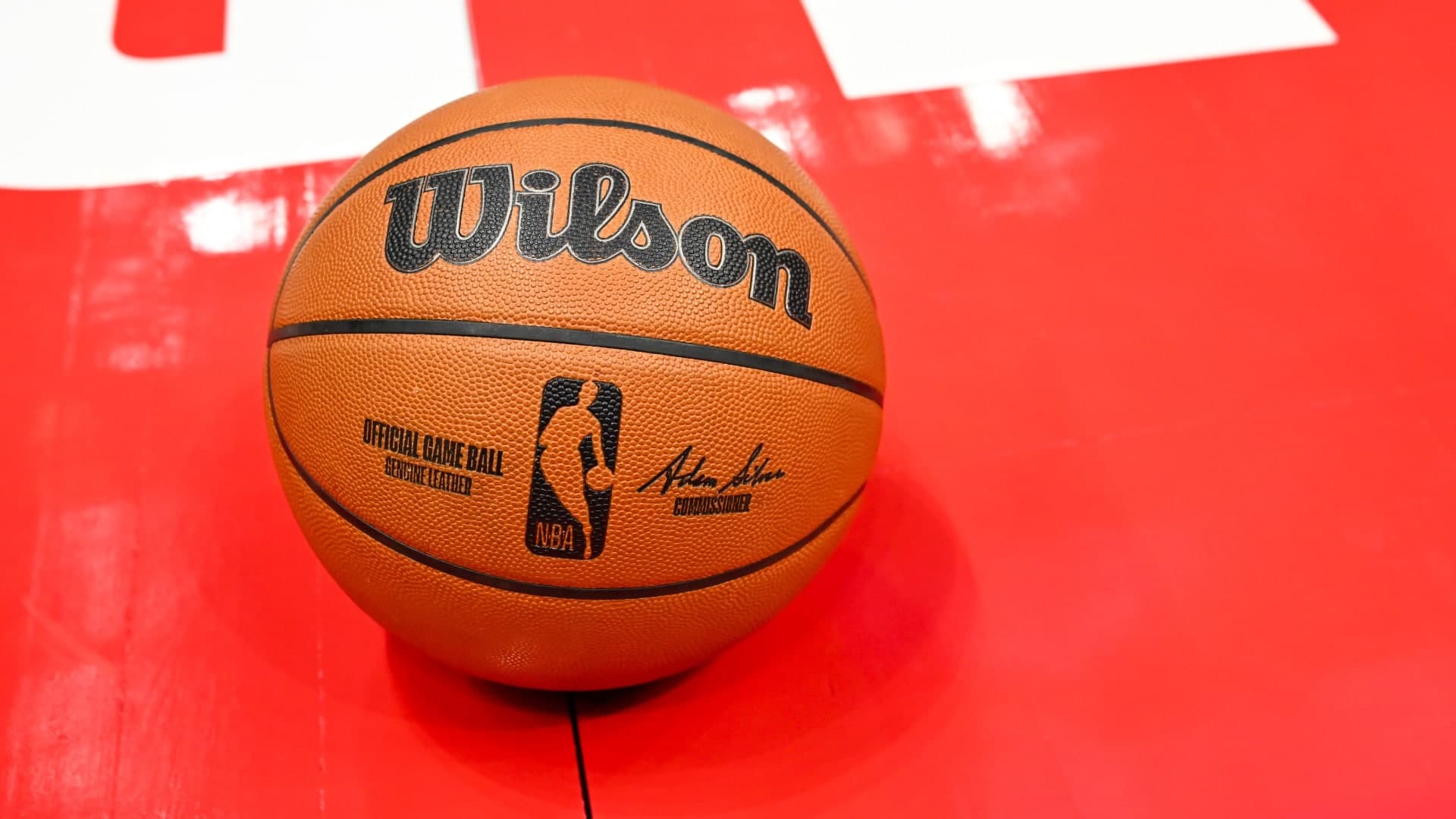
The NBA is testing the Wilson X Connected Basketball in select preseason games, announced in the week of October 9, 2026. A Bluetooth sensor sits inside the air valve and adds about one gram, roughly a six-hundredth of the ball's weight according to the league. It sends real-time measurements, including acceleration, to a handful of antennas around the arena. That data is combined with video and other sources to build models for officiating. Officials, meanwhile, wear wrist devices that track things like replay reviews and scoring changes.
The study is blind, so players don't know whether they are using the smart ball or a standard Official Game Ball. After earlier tests in the G League and at Summer League, players reportedly couldn't tell the difference. The league also says nothing captured will be used to help officials make calls during games, and the technology won't appear in the regular season. For now, this is research. NBA basketball R&D chief Tom Ryan describes it as a way to gather real-time impact data from live play so that models can be built for possible future officiating use.
Enjoying this? Get new articles by email.
The "possible future" part is where the conversation gets interesting. Commissioner Adam Silver has said AI-assisted officiating could automate calls such as out-of-bounds and possession, and in May 2026 suggested automated refereeing could reach the NBA quickly, with instant calls leaving human officials free to concentrate on the subjective decisions. Elsewhere, AI-assisted officiating is already showing up in minor league baseball, NASCAR, NFL first-down measurement and the FIFA World Cup.
The case for it
Accuracy is the obvious win. A ball that knows exactly when it left a hand or crossed a line removes a category of error that human eyes cannot reliably catch at that speed. Fewer wrong calls means fewer games decided by a mistake, and fewer fans and players feeling cheated.
Speed is the second. A sensor can settle a factual question in an instant, which spares everyone the long stoppage while officials crowd around a monitor. Silver's point about freeing referees to handle judgment calls is a good one: let machines do the measuring, and let people do the reading of the game.
Third, consistency. A system applies the same standard in the first minute and the last, in the opening game of the season and in the finals. That kind of impartiality is hard to get from humans under noise, pressure and fatigue.
Finally, there is trust. If a decision is demonstrably right, there is less room for conspiracy theories, which every league has plenty of.
The case against it
The risk is that the game's personality sits exactly in the gray areas that technology is trying to remove. Basketball has always been shaped by what players can get away with, by contact that is almost a foul, by a toe on the line that nobody noticed. Athletes spend years learning to work those edges, and part of the fun for fans is watching someone do it brilliantly. Automate the edge and you risk flattening the craft that lives there.
Then there is feel. Fans don't only want correct outcomes, they want drama, argument and the shared human moment of a controversial call. Take that out and you may get a perfect game that is less fun to talk about afterward.
World football has already given a preview. At a summer 2026 World Cup match between Croatia and Portugal, sensors ruled a Croatian goal offside, and Croatia coach Zlatko Dalić said such decisions take the joy out of football. You don't have to agree with him to see the point: a goal that is correctly cancelled by a measurement the crowd can't see or feel still lands as a loss of the moment.
There are practical worries as well. More data means more questions about who owns it, who can access it and what else it gets used for. Once a ball is also a data source, the temptation to turn it into analytics, betting products or broadcast graphics follows naturally, even though the NBA says nothing captured will be used in games.
Where this leaves brands and fans
The most thoughtful part of this experiment is its restraint. Wilson's focus is making the sensored ball behave exactly like the normal one, and the NBA is testing quietly before it commits. That is the right order of operations: prove the technology disappears into the experience before you ask anyone to trust it.
For anyone building smart products, whether for sport, home or retail, that is a transferable lesson. AI works best when it improves accuracy without changing what people love about the activity itself. The goal is a game where the machine is invisible, the calls are right and the players still get to be gloriously, creatively human at the edges.
Source: Fast Company