
South Africa Took Over a Corner of Paris. Brands Should Take Notes.
It is easy to say that African design is "having a moment." It is harder, and more useful, to look at what the work in the room actually does.
At Maison&Objet, the twice-yearly design show on the outskirts of Paris, the 2026 Rising Talent spotlight went to South Africa. The programme gives one country's selected designers a show within the show, and this year it was a new collaboration between Maison&Objet and Decorex Africa. Seven designers and studios were presented to buyers, journalists, architects and designers, drawn from Johannesburg, Cape Town, Durban and beyond. Stephen Treffinger covered the group for Design Milk, describing South Africa's "distinctive mix of craft, cultural heritage, and contemporary design." [Design Milk]
A fair spotlight is a sign of attention, not proof of a global shift, and the article doesn't claim one. But what is worth studying is the quality of the thinking on display.
Enjoying this? Get new articles by email.
Work that starts from a story
Almost every designer in the group began with something personal or cultural, and then found a form for it.
Meetlo Studio, founded by Oageng Manana and Tshegofatso Ramothibe in Johannesburg, reimagines everyday objects such as a wine rack and a server in forms rooted in South African tradition. The Abadimu server takes its name from words meaning "for the ancestors," and all the carving is done in-house. Manana puts the approach simply: "We try to express our work through our African narrative and our cultural customs." [Design Milk]
Simphiwe Mlambo, in Cape Town, built his collection from his grandmother's grass mats. A bench evokes her loom, wall panels reference the mats, and lamps recall the light she wove by, using a largely traditional palette adapted for a contemporary audience. His aim is to "take personal experiences and traditional techniques and translate them into a modern context." [Design Milk]
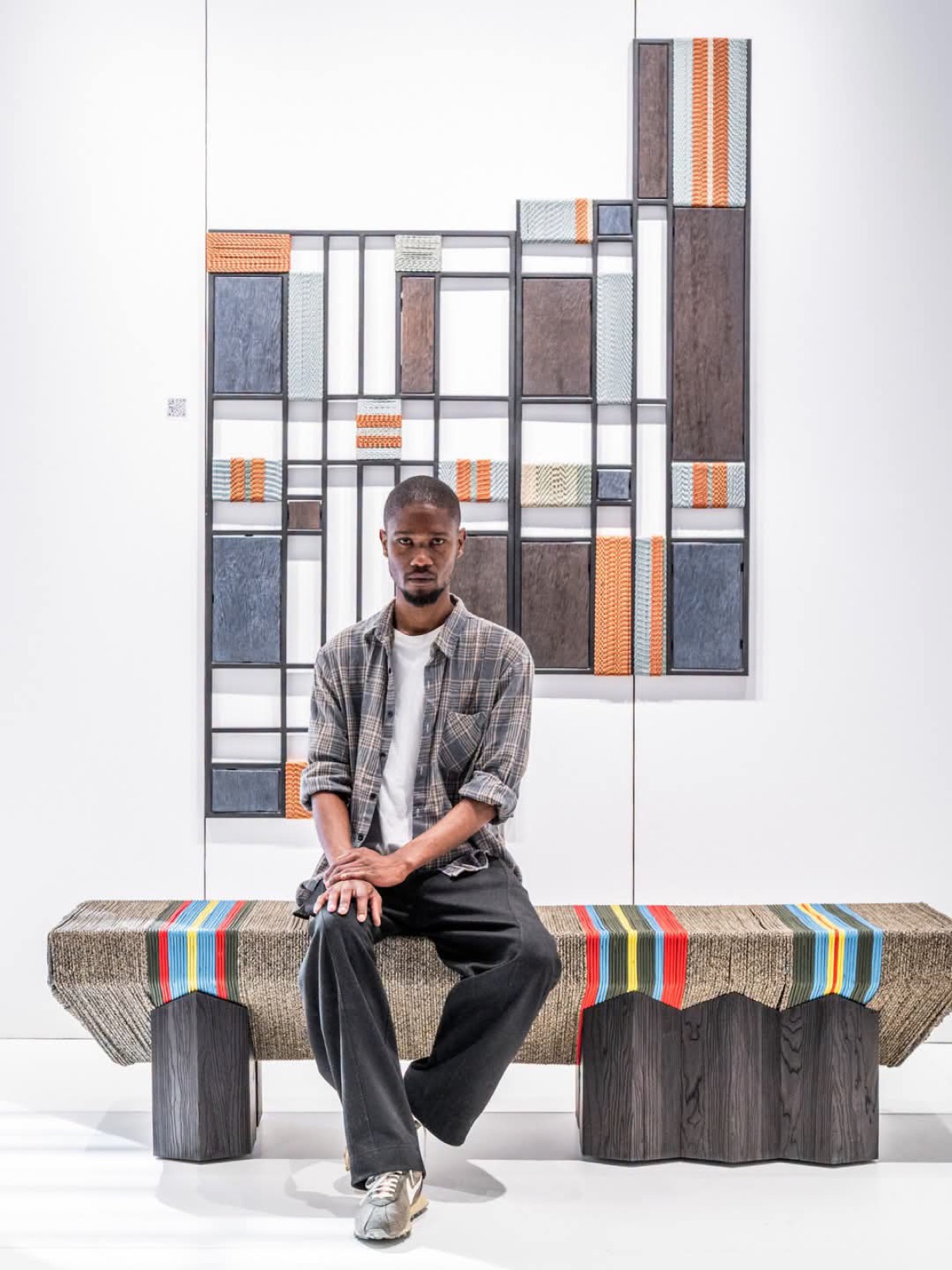
Simphiwe Mlambo with pieces from his collection. Image: Simphiwe Mlambo, via Design Milk.
Siyanda Mbele of Pinda Interior Design in Durban named his studio after the isiZulu word phinda, meaning "again," a nod to repetition and rhythm. He draws on Nguni, Zulu and Ndebele cultures, and showed a wall hanging with diamond and triangle motifs from Zulu culture, symbols linked to beaded bracelets given in courtship. [Design Milk] The story of the object is built into its pattern.
An agile mix of backgrounds
The other thing that stands out is how varied the designers' paths were, which may explain the freshness of the work.
Tanisha Neill of NISH began as a dancer and links that to her sense of rhythm and perspective. Her rug, which can also hang as a wall piece, is hand-tufted in wool and silk with varying pile heights, and was developed with a collage artist who tears and layers vintage magazine images into a mountain landscape with birds. She describes letting the material shape the outcome as part of the process. [Design Milk]
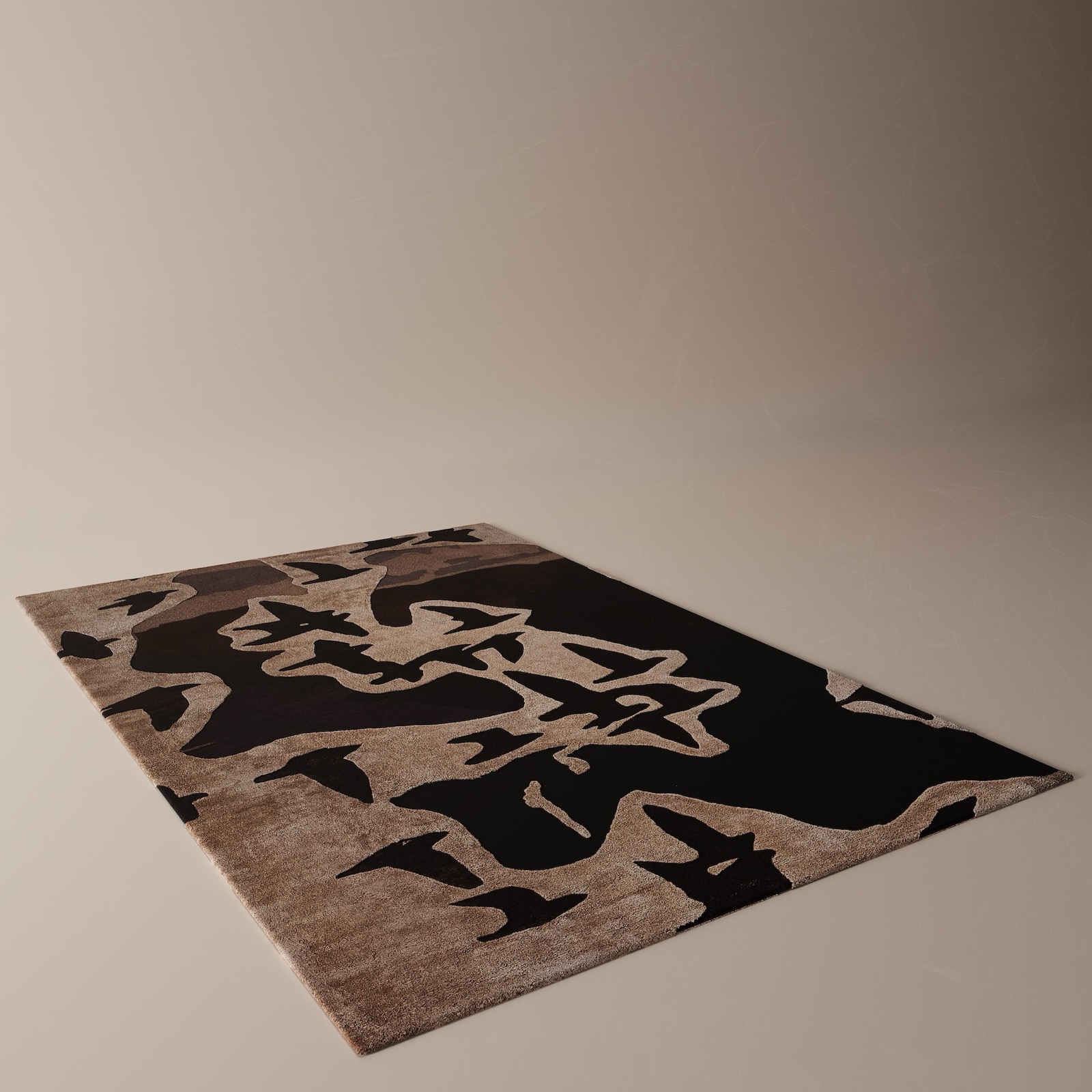
The Bjorn rug by NISH (Tanisha Neill). Image: NISH.
Karlien van Rooyen has a background in neuroscience and loves free diving, which feeds organic forms that resemble anatomy, coral and mushrooms. Her ceramics are hand-built from stoneware, and her wooden works are carved from African teak, fused and carved down into something she calls "almost like a brutalist monument." [Design Milk] Siyanda Mbele moved into design from engineering. Martin Tallie and Zani Alberts of DEFT Studios began as architects and became self-taught woodworkers during the pandemic, now making everything in-house with a small team. [Design Milk]
Ashleigh Lloyd of Studio Lloyd, known for large-scale lodges and resorts, came to Paris with smaller residential pieces, including limited-edition table and pendant lamps in aluminium, stainless steel and weather-resistant synthetic rope. Her crochet-based technique ties to supporting women and community, and she says crochet "offers a deeply human counterpoint to the rigidity of architectural lighting." [Design Milk]
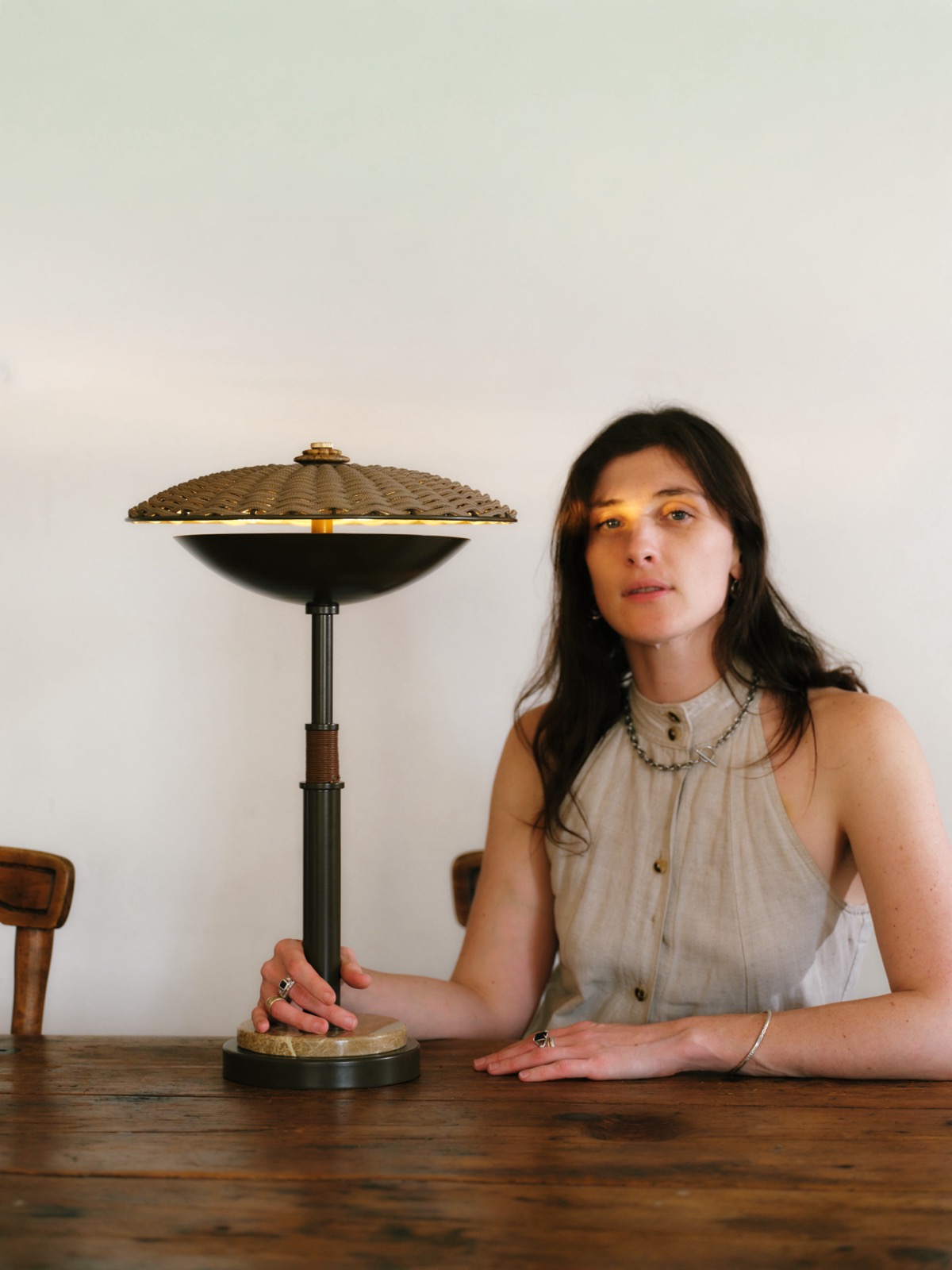
A lamp from Studio Lloyd's Phase Collection. Image: Studio Lloyd.
These are people who moved between fields, picked up new skills quickly and let each discipline change the next. That is what agility looks like in practice.
A note on "vibrant"
It is tempting to sum up work like this with a few bright adjectives, such as lively, energetic and colourful. Some of it is. But the range in this group argues against a single flavour: there is quiet, tactile craft, there is brutalist carving, there is playful rhythm. Africa is a continent of many cultures, and South Africa alone holds several of the ones named here. The more respectful reading, and the more useful one for brands, is to see each designer as having a specific story, not as representing a single "African look."
What brands can learn
For brands looking for a breakthrough in how they talk about themselves, several lessons come straight from the room.
Start with a real story. Mlambo's grandmother's mats and Mbele's courtship bracelets work because they are specific, personal and true. Brands often try to find meaning by borrowing it. These designers found it at home.
Let craft be visible. In-house carving, hand-tufting and hand-built ceramics give the work a credible origin. Customers can feel the difference between an object that was made and one that was merely produced.
Take people seriously as part of the product. Lloyd's crochet technique is explicitly tied to supporting women and community. When the way something is made carries a value, the value becomes part of what the customer buys.
Hire for range, not only for sameness. A dancer, a neuroscientist, an engineer and two architects all ended up as designers, and the work is richer for it. Brands that bring in people from other fields often get fresh answers to old questions.
And let names mean something. Abadimu and phinda are not decorative labels. They carry intent, and they invite the audience to ask what the word means.
The takeaway
The most encouraging thing about this group is not that Paris noticed. It's that the work didn't need to explain itself to be understood. It brought a clear point of view, a strong sense of place and a willingness to cross disciplines. For brands trying to find new meaning in a crowded market, that is a useful template: know where you come from, make it visibly well, and stay open to what other fields can teach you.
Sources