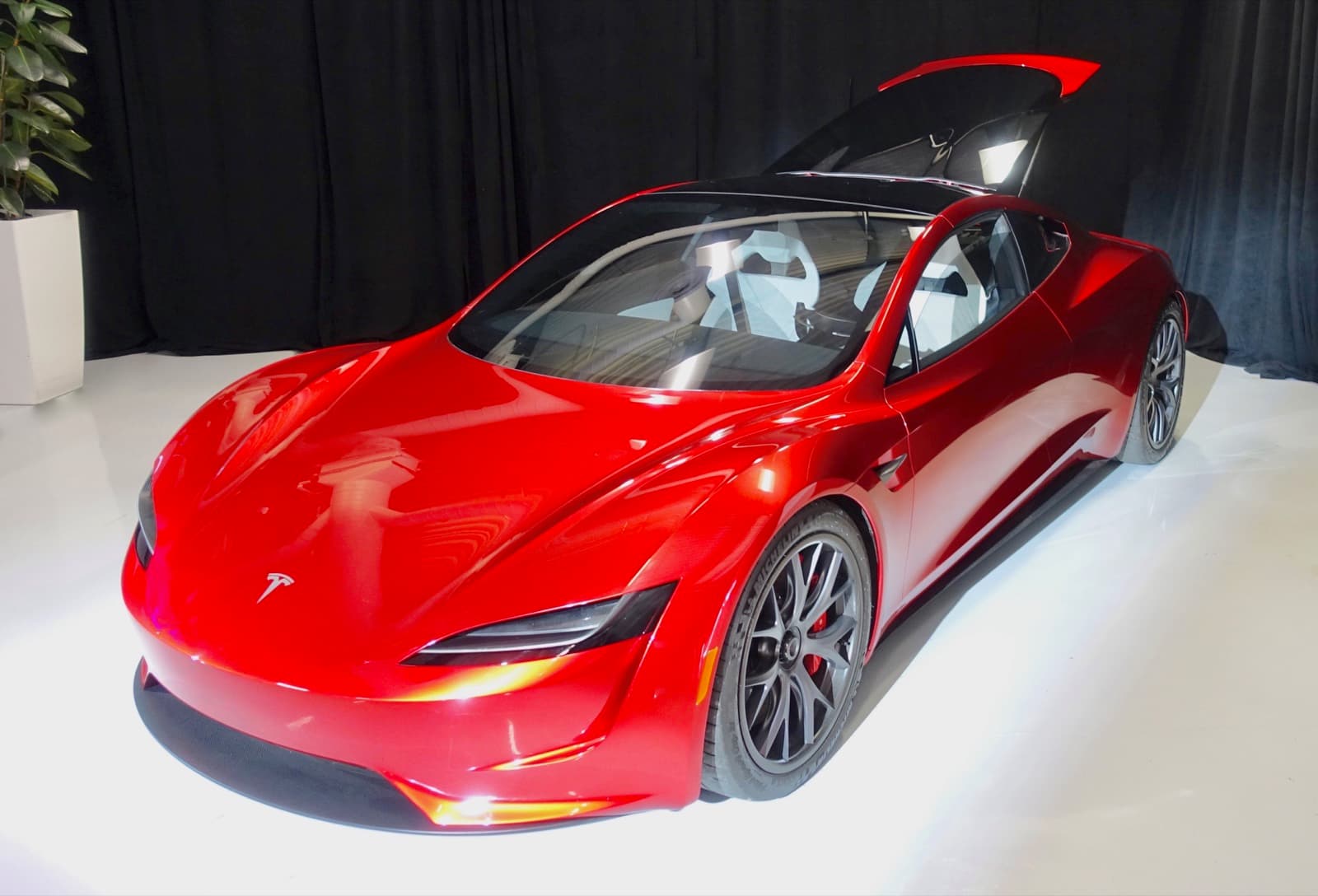
Tesla's Flying Roadster Is Real-ish. Here's What It Means for Cars, Brands and Parking Spots.
The future has arrived, the internet has noticed, and the first thing it did was ask where you're supposed to park.
On October 15, 2026, Tesla showed off its long-delayed second-generation Roadster at a SpaceX test site in Texas, in a livestreamed demo. The car climbed a curved ramp, hung upside down, launched off the end, rolled 180 degrees in the air and landed on its wheels, then used thrusters to hop over other vehicles. Elon Musk's caption on X: "Turns out the future does have flying cars." [Fortune; CBS News]
Before we get excited, a little cold water, because this is a column about strategy and not a fan page. Let's separate what's real from what's a very good trailer.
Enjoying this? Get new articles by email.
What actually happened
The Roadster does not fly like an aircraft. It uses a SpaceX-developed thruster package running on compressed air, which Tesla engineering VP Lars Moravy said comes from roughly 600 litres of rechargeable air, and which Dezeen reports can fire to lift the car and cushion its landings. [Fortune; Dezeen] The demo was a short, pre-programmed sequence with no driver at the wheel, and Musk said himself that success was "not guaranteed" and that the car was "not necessarily a safety-optimized car." [CBS News; Dezeen; Fortune] Tesla hasn't said how long or how far it can stay airborne. [Fortune]
The line-up, as reported, runs from a road-going Performance version with active aerodynamics, to a Thrust model with rear cold-gas thrusters and a claimed 0–60 mph in under a second, to an invitation-only single-seat Rocket version with ten thrusters. Production is slated for 2028. Tesla's website says the flying model is "not approved for public road use." [Fortune; Dezeen] Reported deposits range from $5,000 for the non-flying car to $250,000 for the Thrust version, though outlets don't agree on every figure, so treat the numbers as provisional. [CBS News; Fortune]
Regulators, meanwhile, are in a fine pickle. The FAA told CBS News the vehicle doesn't meet its definition of an aircraft, while NHTSA largely relies on automakers to self-certify, and it's unclear who would oversee the flight features at all. [CBS News; Fortune]
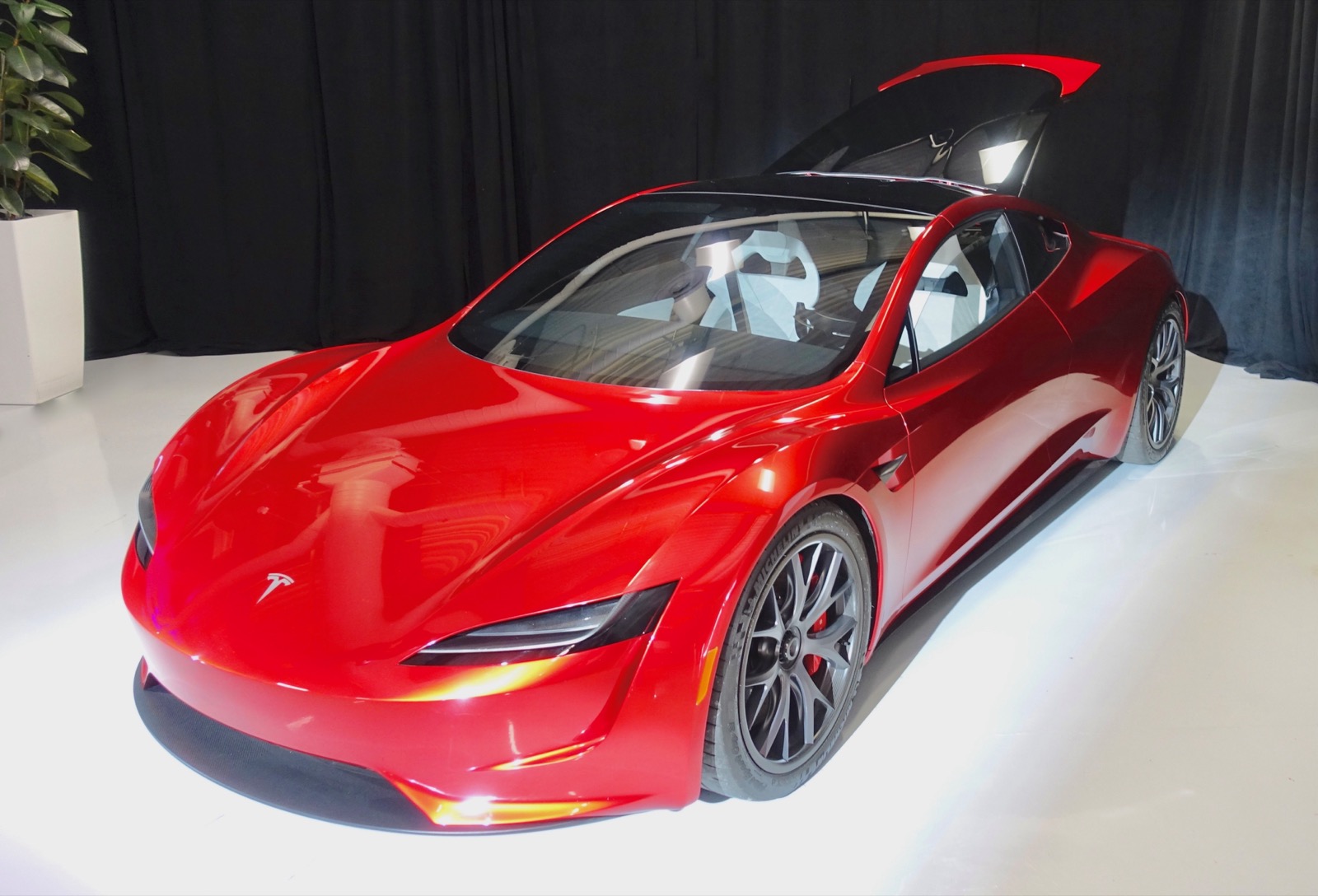
Photo: Steve Jurvetson, CC BY 2.0, via Wikimedia Commons. This is the Roadster prototype as shown publicly since 2017, photographed in 2019 — not the October 2026 flying demo car.
The memes arrived before the paperwork
The internet, as usual, got there first. One viral clip showed a Suzuki Mehran sailing over Islamabad's roads, captioned "Raja Ji in action." Indian users posted a car escaping a traffic jam by flying, then getting tangled in overhead wires. [Aaj English TV] Others turned the Roadster into revenge on the slow minivan in the fast lane, a "Back to the Future" edit with Musk as Doc Brown, a fake sign reading "Kickflips Allowed, Roadster Only," and a Michael Scott face for the insurance industry. [Thunder Dungeon] Over on X, jokes ranged from a police car taking off in pursuit to people pointing out that the flying car arrived before GTA 6. [Twitchy; Aaj English TV]
And then there is parking. An X account called TeslaZoa reportedly posted a ten-second clip on October 17 showing Teslas stuck nose-up to a building wall, asking whether this was the future of parking, according to a summary by AGTP Insights. [AGTP Insights] Let's be clear for the record: parking your Tesla vertically on someone's building is, as of this writing, not legal, not possible and a quick route to a very awkward conversation with a landlord. It is, however, a perfect meme, because it asks the question every city planner is quietly dreading. If cars can leave the ground, what happens to the ground?
Watch and see
Watch: Tesla's official livestream of the Roadster event, via X
Watch: "Did Tesla just unveil a flying car?", BBC News
Mock-up video (not official footage): iamneubert, via Facebook
Post: @TeslaZoa, via X
How this flips the auto industry (and how it doesn't)
Here's the grown-up part. Analyst Dan Ives was blunt that the Roadster "will not move the volume or revenue needle," and TechCrunch called it a halo car, meant to show off Tesla's technology rather than to sell in bulk. [CBS News; Fortune] That is probably right. A pricey two-seater arriving in 2028 will not rewrite Detroit's spreadsheets.
The real flip is on the other side of the screen. A halo car changes what the whole category is allowed to promise. For a century, car brands competed on speed, comfort and badge. A flying demo moves the conversation from "which car is nicest" to "which company owns the future," and that pulls in rocket engineers, regulators, insurers and city governments. Even Dezeen noted that Tesla framed it as a collaboration between "the world's best car company and the world's best rocket company." [Dezeen; CBS News] Expect rivals to answer with their own spectacle, not their own spec sheet.
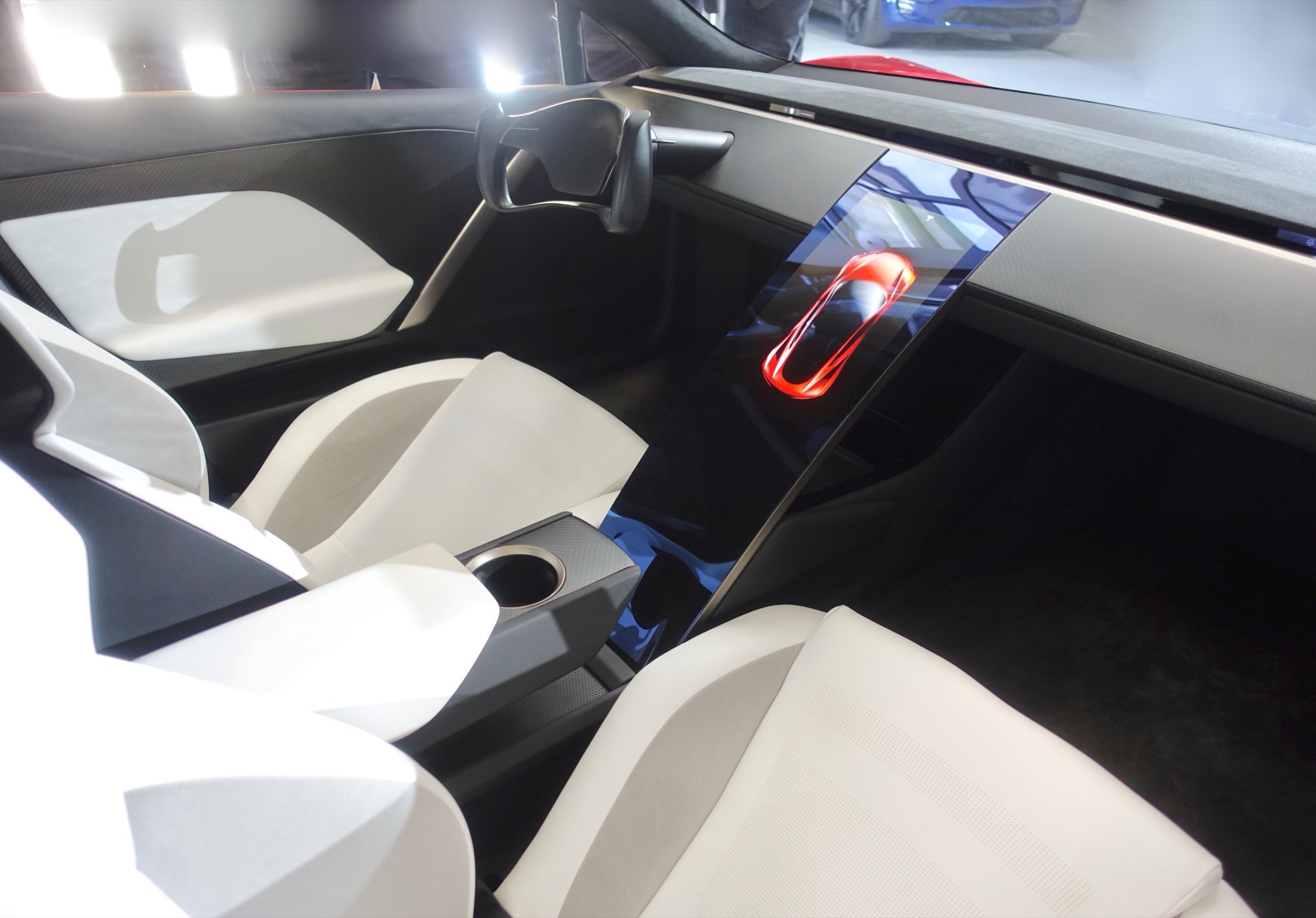
Photo: Steve Jurvetson, CC BY 2.0, via Wikimedia Commons. Prototype interior, photographed in 2019 — not the October 2026 flying demo car.
Where the commercial opportunities are, if it ever reaches regular production
None of this exists yet, and I'm speculating here, so read the rest as a strategist's sketch rather than reporting.
Insurance is the obvious first gap. Nobody has a policy for a car that hops, and the company that builds one early gets to write the rulebook. Infrastructure follows: landing zones, charging for air tanks, and rental or experience fleets that let people try a flight without owning one. Training and certification becomes a business, because someone has to teach drivers what to do when the road is optional. And content, maybe the biggest, because a car that does something this cinematic is a media asset as much as a vehicle: events, films, games and limited merchandise all hang off it.
Which brands could make the drivers' experience better
These are my suggestions, not announced partnerships. Where it makes sense, I've matched brand strengths to real needs in the cabin.
Tyre and brake specialists, such as Michelin or Brembo, have an obvious role, since a car that lands needs wheels and stopping power that expect impact. Seating and safety names like Recaro or Bell could help with the very thing Musk admits the car isn't optimised for, which is surviving the ride. Audio and sound brands, such as Bang & Olufsen (who we looked at last week for a different reason), could design the cabin soundscape for a vehicle where engine noise is no longer the main event. Luggage and travel brands like Rimowa would be natural for a car where every gram of cargo matters. Action and adrenaline media, think Red Bull, already knows how to turn stunts into content. And insurers, from the global names to nimble start-ups, may be the most important partners of all.
The pattern holds across all of them: the best partner is one that solves a real problem created by the new capability, not one that just wants its logo near a rocket.
The honest takeaway
A flying car that hops over other cars on a test track is not a flying car in the way the word has promised for decades, and several outlets said as much. [Aaj English TV; Fortune] But it did something valuable: it made everyone talk about what comes next. Brands should treat the Roadster less as a product to sell and more as a prompt. The question for any company near mobility is simple: if the road became optional, what would customers need from me?
Meanwhile, please don't park on the wall.
Sources and visual credits
- Fortune, "Tesla is taking $250,000 deposits for a Roadster with SpaceX thrusters. The FAA says it isn't an aircraft," Oct 17, 2026
- CBS News, "With Tesla Roadster debut, Elon Musk shows 'flying cars are real'"
- Dezeen, "Tesla launches flying Roadster concept car," Oct 16, 2026 (Dezeen credits its imagery to Tesla.)
- Thunder Dungeon, Tesla flying car memes
- Aaj English TV, "Tesla's 'flying car' takes off on social media as memes go viral"
- Twitchy, "More Musk Tesla Roadster memes"
- AGTP Insights, summarizing a TeslaZoa post (Oct 17, 2026)
- Watch: Tesla's official livestream of the Roadster event, via X
- Watch: "Did Tesla just unveil a flying car?", BBC News
- Mock-up video (not official footage): iamneubert, via Facebook
- Post: @TeslaZoa, via X
- Brand-partner ideas and commercial opportunities are the author's own analysis, not reported facts.
- Meme images are not reproduced. Each is linked or described and remains the work of its original creator.
- Tesla Roadster photos: Steve Jurvetson, licensed CC BY 2.0, via Wikimedia Commons. Depict the 2017-design prototype, photographed in 2019 — not Tesla's own October 2026 launch photography.