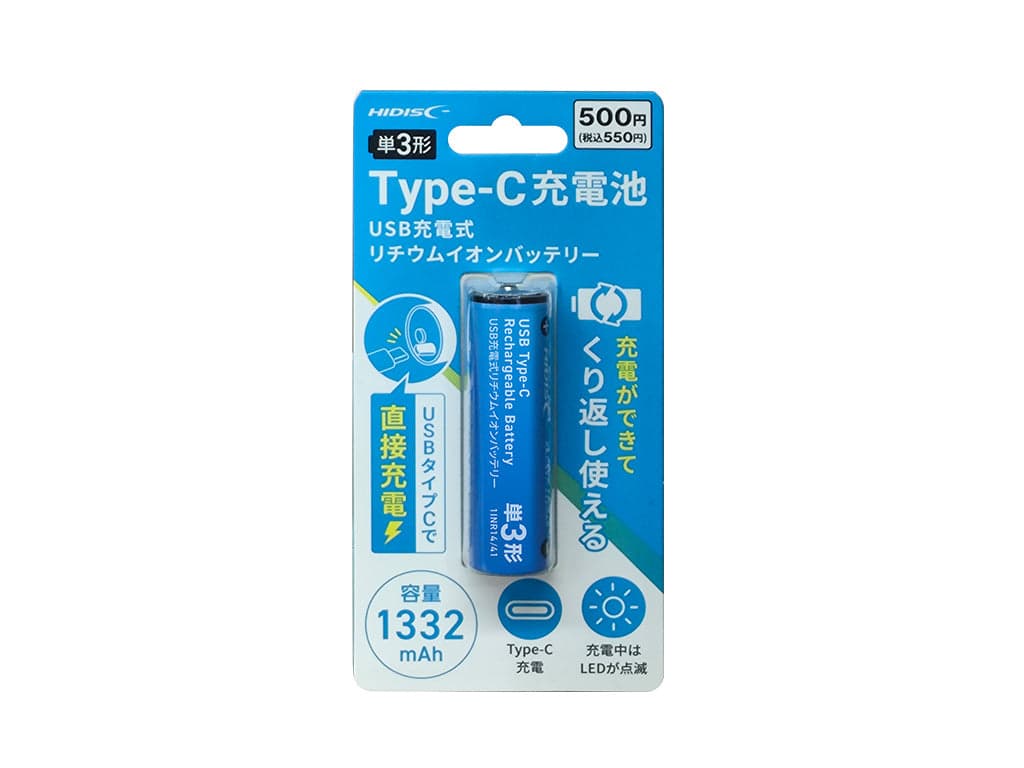
Photo: DAISO
The Humble AA Battery Just Got a USB-C Port. Nobody Asked, and That's Fine.
Somewhere in a Daiso aisle, wedged between seasonal umbrellas and novelty stationery, sits one of the more sensible pieces of product design to show up this year: an AA battery with a USB-C port built directly into its shell.
That's the whole pitch. No app, no subscription, no "smart" anything. You plug a cable straight into the battery itself — the same one already charging your phone, your laptop, your power bank — and about ninety minutes later it's full. HIDISC, the Japanese manufacturer behind it, kept the input spec deliberately modest: 5V at 0.5A, so low-power it'll happily take a charge from an ancient laptop USB port or one of those tiny chargers that used to ship with old feature phones. Nothing about this is flashy. That's rather the point.
It would be easy to read this as a novelty — the kind of quirky Daiso find that gets a hundred thousand social shares and then quietly disappears from shelves. But it's worth taking seriously as something else: one of the first genuinely convenience-minded answers to a design problem the entire battery industry has mostly ignored for decades. Rechargeable batteries have existed for a long time. What's been consistently missing is frictionless rechargeability — the kind that doesn't require you to own, locate, and pack a separate dedicated charger every time. A staggering number of everyday objects still run on disposable or single-format batteries, quietly generating waste, purely because switching to rechargeables has always meant adding one more proprietary charging brick to your life. Solve that friction, even slightly, and you make the sustainable choice the lazy choice — which, historically, is the only kind of sustainable choice that actually scales.
Enjoying this? Get new articles by email.
The genuinely clever part is what this format quietly unlocks: bi-directional convenience. This isn't a battery you can only charge — it's a battery you can charge from literally anything with a USB-C output, including devices most people already own and carry. A dead wireless mouse in an airport lounge becomes solvable with whatever's already in your bag, no separate charger required. That's a meaningfully different value proposition than "eco-friendly," even though it happens to also be eco-friendly.
There's a more serious version of that same convenience worth sitting with, too: emergency and medical contexts. Devices that rely on standard AA cells — from flashlights to certain home medical equipment — are often exactly the things people reach for during a power outage or a travel emergency, precisely when a dedicated charger is least likely to be within reach. A battery that can pull a charge from a power bank, a laptop, or a car's USB port isn't just a camping convenience; it's a meaningfully more resilient option for situations where "I don't have the right charger" genuinely isn't an acceptable answer.
None of this is to oversell what's still, honestly, a fairly rough first draft. The battery holds a stable 1.5 volts all the way through its charge, which is genuinely better than the 1.2V wobble of typical nickel-metal hydride rechargeables for power-hungry devices — but that same steadiness means you lose the usual early-warning sign of a dimming flashlight, so you don't get much notice before it just stops. Capacity checks in at 1320mAh, meaningfully below the roughly 2000mAh you'd get from a standard rechargeable, since carving out room for a Type-C port and step-down circuitry inside a AA-sized shell means sacrificing actual cell volume. And at around 300 charge cycles, it won't outlast dedicated rechargeables built for the long haul.
None of that erases the point, though. This is what genuine progress in unglamorous product categories actually looks like: not a leap, but a small, structurally honest improvement that quietly removes one piece of friction between people and the more sustainable choice. The AA battery has gone essentially unchanged for the better part of a century. It didn't need reinventing. It just needed someone to finally ask why charging one still required a separate box.