Photo/Design: Jisu Yoon
This Sofa Is Built From the Same Wire Doctors Put in Your Arteries
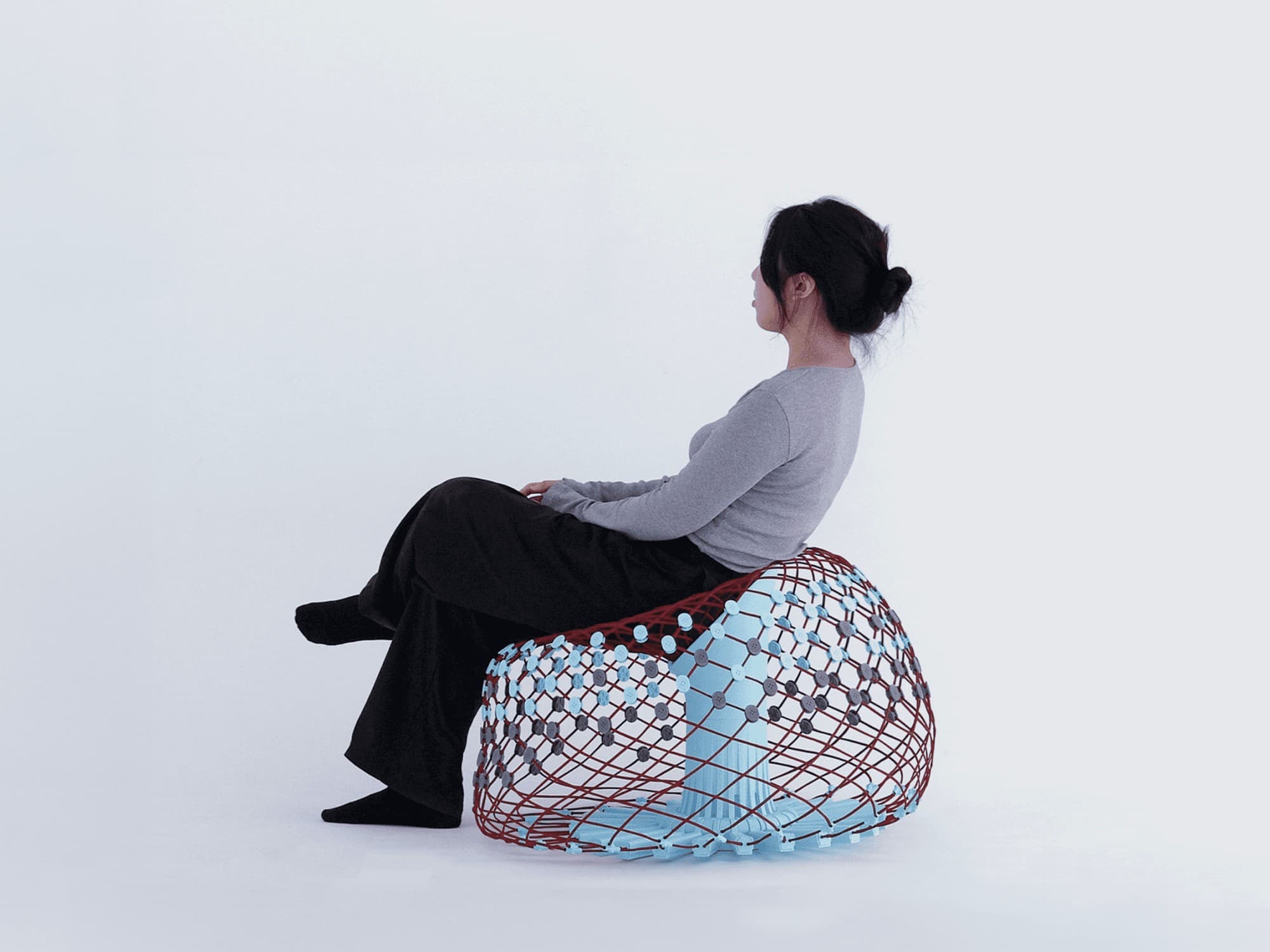
Every flat-pack sofa makes the same quiet promise: assemble once, live with it forever, never think about the instructions again. Seoul-based designer Jisu Yoon looked at that promise and asked a much stranger, much better question — what if furniture didn't have to choose between "flat-packed" and "finished," and could just move fluidly between the two, indefinitely, the way certain materials already do inside the human body?
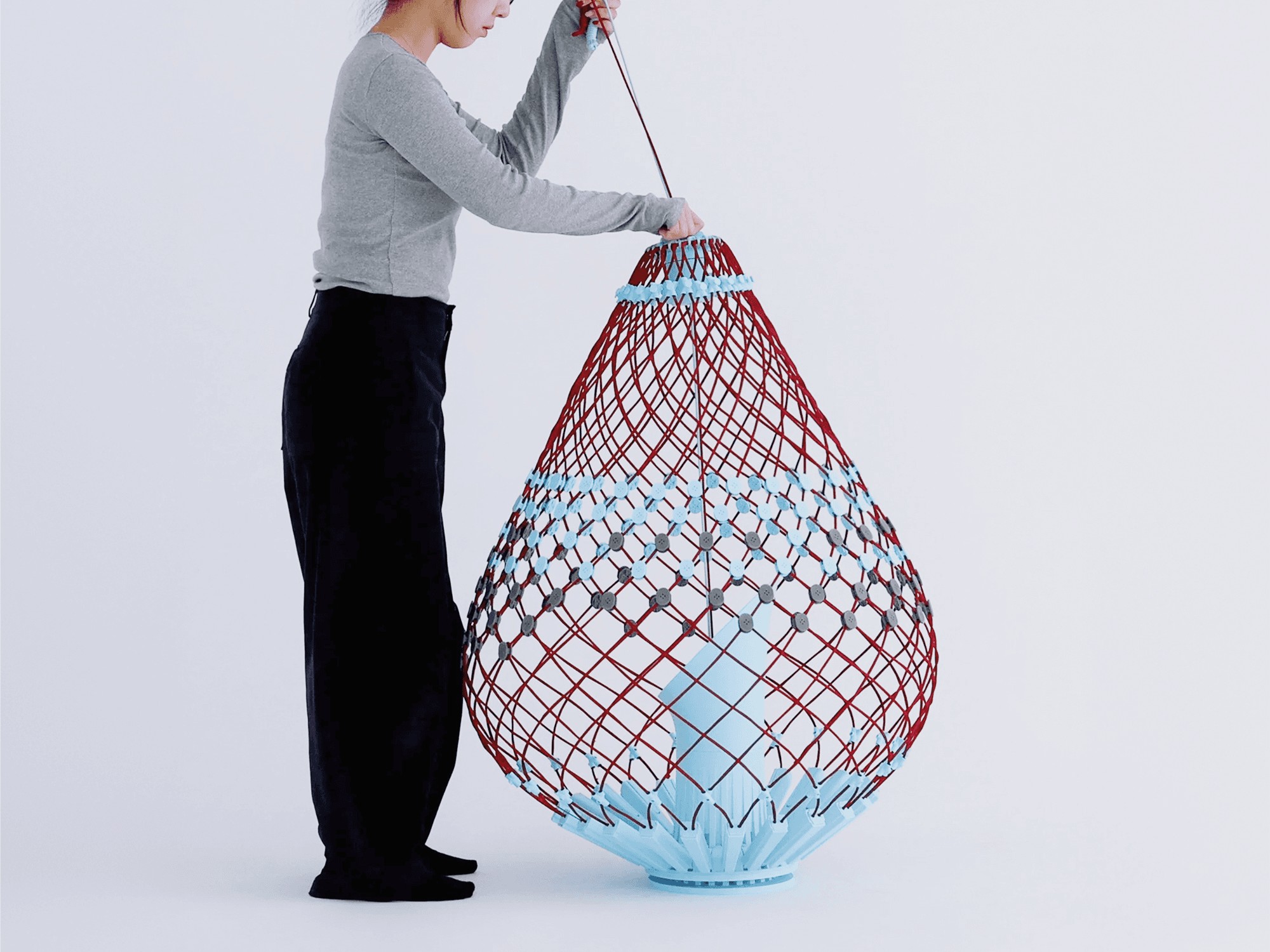
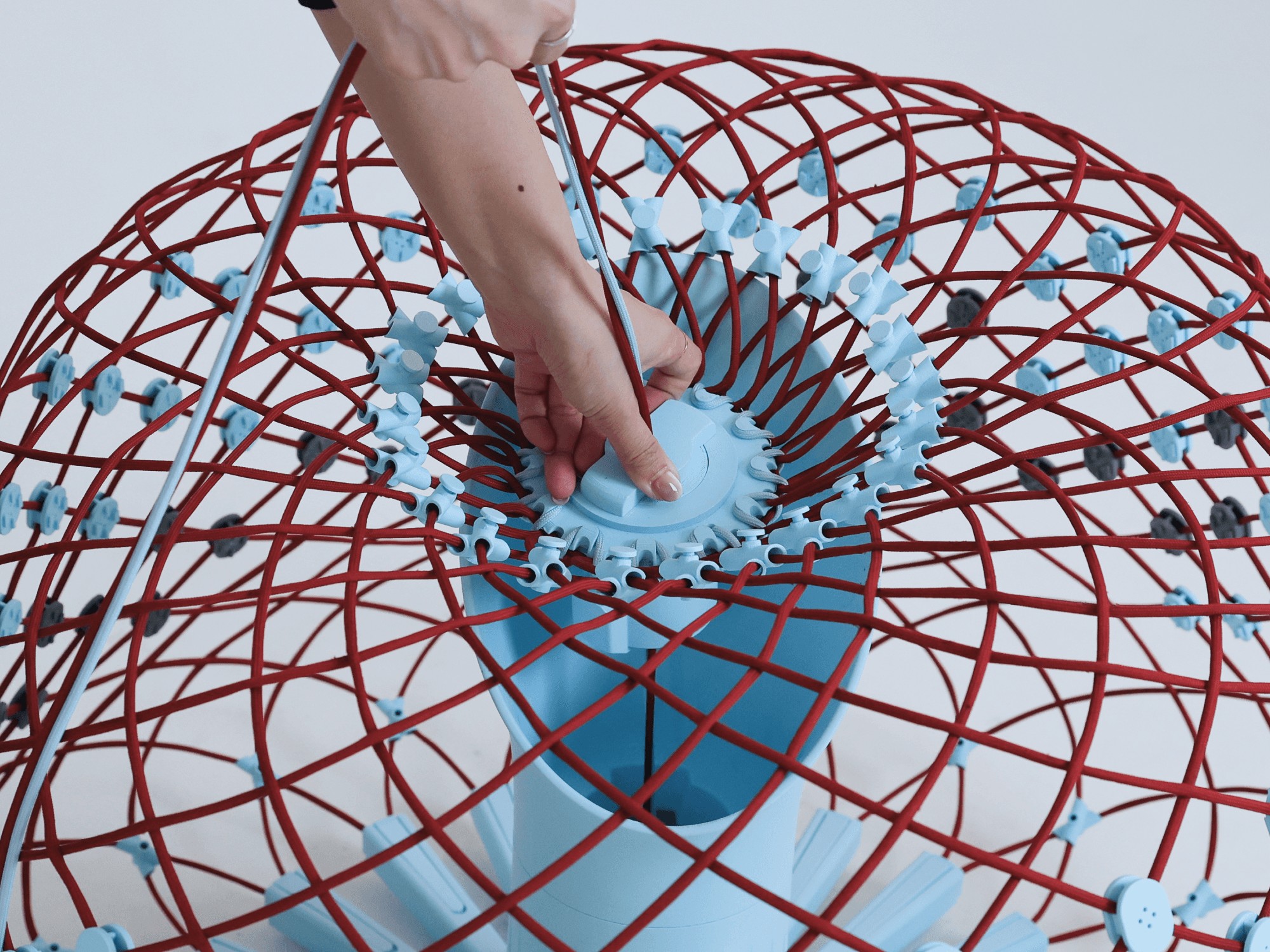
Her answer is the Re-flat pack sofa, built almost entirely from nitinol — a nickel-titanium shape-memory alloy best known for its work inside heart stents and aerospace mechanisms, prized for one very specific talent: deform it, and it remembers exactly how to snap back to its original form. Threaded inside red fabric cords, hand-woven and laced into 3D-printed joints, a central hub manages the tension across all those wires and locks the whole structure into shape the moment it's deployed. No separate frame. No cushion stuffing. No leftover screw silently judging you from the carpet. Fully expanded, it's a 700mm lounge seat. Collapsed, it folds down to a slim 250 x 250 x 1430mm column — something you could genuinely carry under one arm.
Enjoying this? Get new articles by email.
Photo/Design: Jisu Yoon
It took roughly a year and a half of testing across steel wire, carbon rods, nylon rope, and glass fibre before nitinol won out, and the reason it won is the actual insight worth sitting with: foam compresses, but it doesn't remember. Every other flat-pack solution treats "assemble once" as an acceptable limitation. Yoon specifically ruled that out — she wanted something that could collapse and redeploy repeatedly without degrading, which meant reaching for a material built for a context where failure genuinely isn't an option.
Photo/Design: Jisu Yoon
That's the detail that elevates this past a clever design-school exercise. Nitinol wasn't chosen because it sounded impressive on a spec sheet. It was chosen because the medical and aerospace fields already solved, decades ago, the exact structural problem furniture designers keep working around with foam and screws: how do you build something that can be radically compressed, deployed, and trusted to hold its precise shape, over and over, without ever quite breaking down? A heart stent has to collapse to fit through a catheter and then expand to hold an artery open reliably for years. A sofa, it turns out, is asking a smaller version of the exact same engineering question.
Which points at something bigger than one sofa. When a material engineered to work safely inside a human body gets picked up by industrial designers for a coffee table's neighbor, the traffic isn't only running one direction. Every new furniture-scale application of a material like nitinol becomes a fresh, low-stakes stress test — more data on how it behaves under repeated deformation, more real-world proof of its reliability outside a lab, more manufacturing know-how built up around handling it at scale. Medical devices have historically had to justify every material choice against enormous cost and testing burdens, in isolation. A living room accidentally becomes a testing ground with better economics.
There's also something quietly optimistic buried in what this unlocks for the body-scale version of this idea. If a shape-memory alloy can be woven, tensioned, and locked into a stable, load-bearing form for a piece of furniture, that same fundamental behavior is exactly what future adaptive medical structures need — devices and supports that can compress to fit where the body needs them and then expand into a precise, dependable shape once they're in place, the way this sofa collapses to the size of a golf bag and reopens into a couch that holds a person's full weight without hesitation. Furniture design isn't going to replace clinical engineering. But watching a shape-memory alloy get put through its paces in a living room, repeatedly, publicly, under normal domestic wear — that's a genuinely useful kind of proof that this class of material can be trusted to keep its shape, again and again, exactly when it needs to.
Yoon's project picked up the SIT Furniture Design Award 2026 after starting life as a graduation piece — the kind of project that usually gets photographed once at a degree show and quietly disappears. This one reads more like an opening question than a finished answer: not just a smarter way to ship a sofa, but an early, genuinely bold argument for what happens when the same material a body learns to trust also has to hold up a person's weight on a Tuesday night.